Small interiors call for well-considered decisions, especially when a table sits at the centre of everyday life. It is where we eat, work, meet loved ones and celebrate important moments. The right table for a small flat can do more than serve its practical purpose – it can also bring order to the space and emphasise the style of the interior. The key is to choose the right design, proportions and materials so that the table does not overwhelm the room. In this article, we show you how to plan a table in a compact interior so that it is functional, attractive and timeless.
How to choose a table for a small flat without it dominating the space
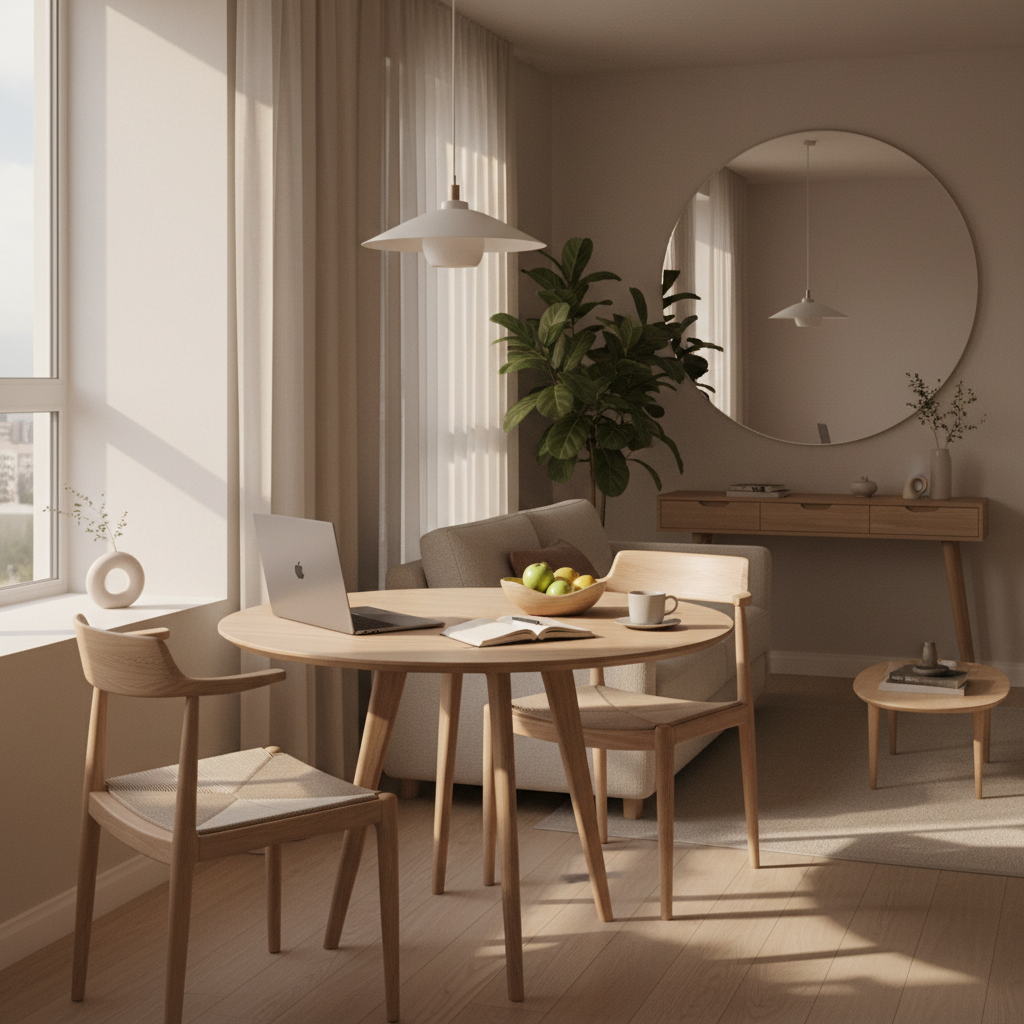
Choosing a table for a small flat should start with an assessment of the available space. The most important thing is to keep freedom of movement – the table must not block walkways or visually "close off" the room. That is why designs with a light form and slender proportions work best in small rooms.
Pay attention to the shape of the top. Round tables or tables with rounded edges are safer and more ergonomic in a limited space. Rectangular designs also work well, as long as their length suits the size of the room.
The base of the table matters too. Thin legs or a central pedestal make the piece look lighter so that it does not overwhelm the interior. This is particularly important in studio flats and small apartments.
Key rules for choosing a table:
- a compact tabletop
- a visually light construction
- a shape that suits the layout of the room
- at least 80–90 cm of clear space around the table


Why should a table for a small living room be multifunctional?
A table in a small living room very often plays more than one role. It can be a place for meals, for working from home and even for socialising. That is why its functionality and flexibility are key.
An extendable design is a particularly good answer to these varied needs. Kept closed most of the time, the table leaves the room open and easy to use, and it can grow whenever the occasion calls for it. Adaptability is what makes it work in a small space.
Thanks to an extension mechanism, the table does not take up unnecessary space when it is not needed at full size. At the same time, it offers plenty of comfort during larger gatherings.
In small living rooms, it is worth treating the table as a "changeable" piece of furniture that responds to the household's needs, rather than imposing fixed functions on the space.
Which materials work best for tables in small interiors?
The material a table for a small flat is made from has a huge influence on how the whole interior is perceived. In compact spaces, materials that reflect light or have a visually light texture work best.
Light-toned solid wood warms up the space and adds natural character without overpowering the room. Oiled tops retain their authentic look and are easy to care for every day. A combination of wood and metal, meanwhile, gives a table a modern yet still light character.
Tops with a slim profile also work well in small living rooms. The less visually bulky the table, the more spacious the room feels. Minimalist form goes hand in hand with functionality here.
Recommended materials for small spaces:
- light natural wood
- thin tops with a straight edge
- slender metal bases
- matt or semi-matt finishes
How to position a table in a small living room to gain space
Where you put the table is just as important as which one you choose. In small living rooms, it is best to place the table close to a wall or window so that it can easily be extended when needed. This keeps the space flexible and easy to rearrange.
Another good solution is to position the table parallel to the sofa or the kitchenette. This keeps the layout coherent and visually tidy. Avoid placing the table in the middle of the room if the floor area does not allow for it.
Lighting above the table matters too. A light pendant lamp will define the dining area and give it a clear function without physically dividing the space.
A well-planned table for a small living room becomes a natural part of the interior rather than an obstacle in everyday life.
Why is the table a key piece of furniture in a small flat?
In small interiors, every piece of furniture has to "work" for its place. The table is one of the most important furnishings, as it connects the different zones of home life. The right design can bring order and rhythm to a space.
A table for a small flat is an investment in everyday comfort. It combines practicality with good looks and lets you make full use of your interior's potential. With a well-considered choice, you do not have to sacrifice either comfort or good design.
It is a piece that adapts to changing needs – from everyday meals to larger gatherings. That is exactly why it should be chosen with care and with your household's lifestyle in mind.